Discover a selection of my research publications and the scientific questions behind them.
Want to go straight to the full papers? Visit my Google Scholar profile.
Peer-reviewed Paper
Learning Brenier Potentials with Convex Generative Adversarial Neural Networks
C. Drygala, H. Gottschalk, T. Kruse, S. Martin, and A. Mütze
Mathematical Foundations of Machine Learning, accepted for publication; arXiv:2504.19779, 2026
We develop a statistical learning framework for generative adversarial networks that learn the Brenier potential, whose gradient transports a source distribution to a target distribution. To model the required second-order structure, we introduce ReCU networks with cubic activations and an adversarial training procedure that combines the standard discriminator loss with a convexity penalty. We prove that, for a sufficiently large penalty, the learned potentials are strictly convex and that the method is statistically consistent as network capacity grows. Experiments on Gaussian mixtures and image data support the theory, showing that the networks learn convex potentials and that the convexity penalty becomes inactive during training.

Generalization capabilities of conditional GAN for turbulent flow under changes of geometry
C. Drygala, F. di Mare, and H. Gottschalk
Proceedings of the 15th European Conference on Computational Methods in Applied Sciences and Engineering (EUROGEN) 2023.
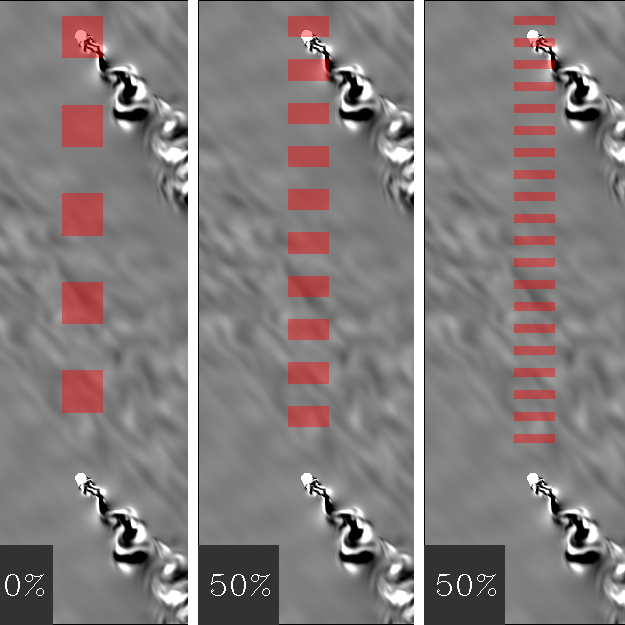
Turbulent flows contain structures across a wide range of spatial and temporal scales, making them expensive to resolve with classical methods such as Large Eddy Simulation (LES). In this work, we investigate conditional generative adversarial networks as an efficient alternative for modeling turbulent flow around a low-pressure turbine stator. To test generalization, we deliberately exclude selected wake positions from the training data and evaluate the model on these unseen configurations. By gradually increasing the size of the excluded regions, we assess the limits of the model’s ability to generalize to geometric changes in the flow setup. Finally, we compare the statistical properties of the generated flow fields with the corresponding LES results.
Comparison of Generative Learning Methods for
Turbulence Surrogates
C. Drygala*, E. Ross*, M.S Ghazijahani, C. Cierpka F. di Mare, and H. Gottschalk
Computational Science and Engineering, accepted for publication; arXiv:2411.16417, 2026
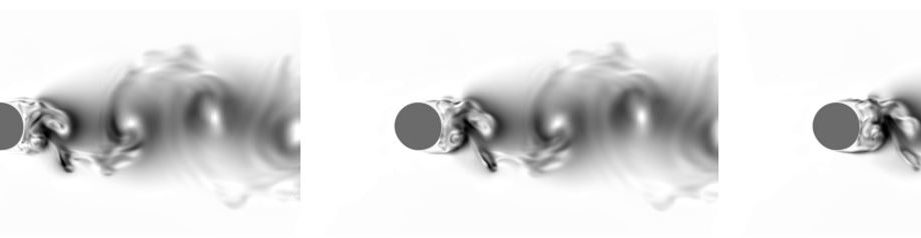
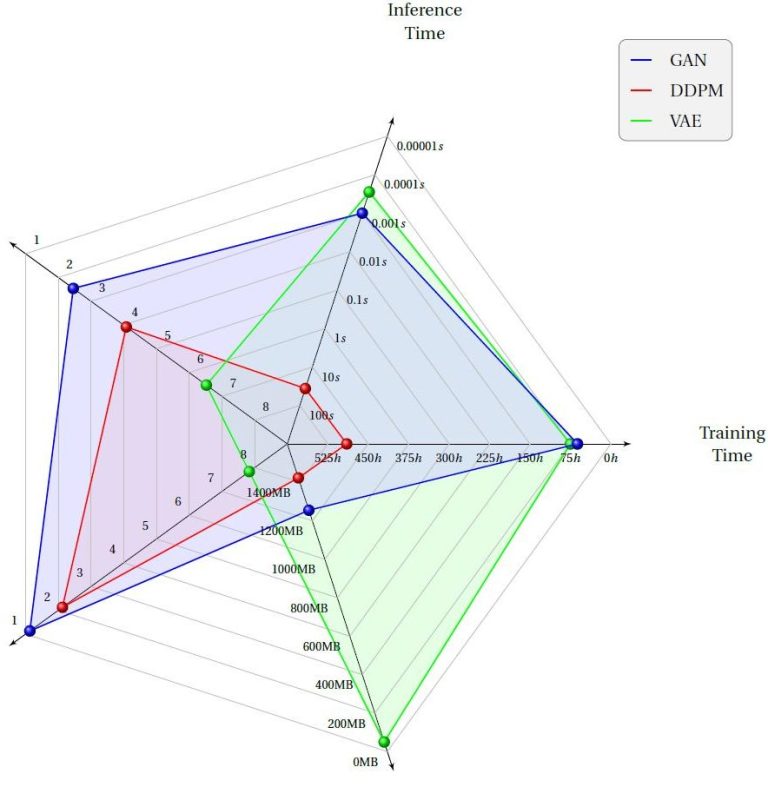
We compare three generative models - Variational Autoencoders (VAEs), Deep Convolutional GANs (DCGANs), and Denoising Diffusion Probabilistic Models (DDPMs) - as surrogates for turbulent flow simulations. The models are trained on a simulated 2D von Kármán vortex street using Large Eddy Simulation (LES) data and on an experimental cylinder-array wake dataset obtained through Particle Image Velocimetry (PIV). Their ability to reproduce the statistical properties and spatial structures of the flow is then evaluated. DCGANs and DDPMs capture the flow distributions most effectively, with DCGANs offering the best overall trade-off through fast training and inference, lower data requirements, and results closely matching the input data. VAEs are faster but less accurate, while DDPMs perform well but are considerably more computationally expensive.
Generative modeling of turbulence
C. Drygala, B. Winhart, F. di Mare, and H. Gottschalk
Physics of Fluids 34, doi: 10.1063/5.0082562
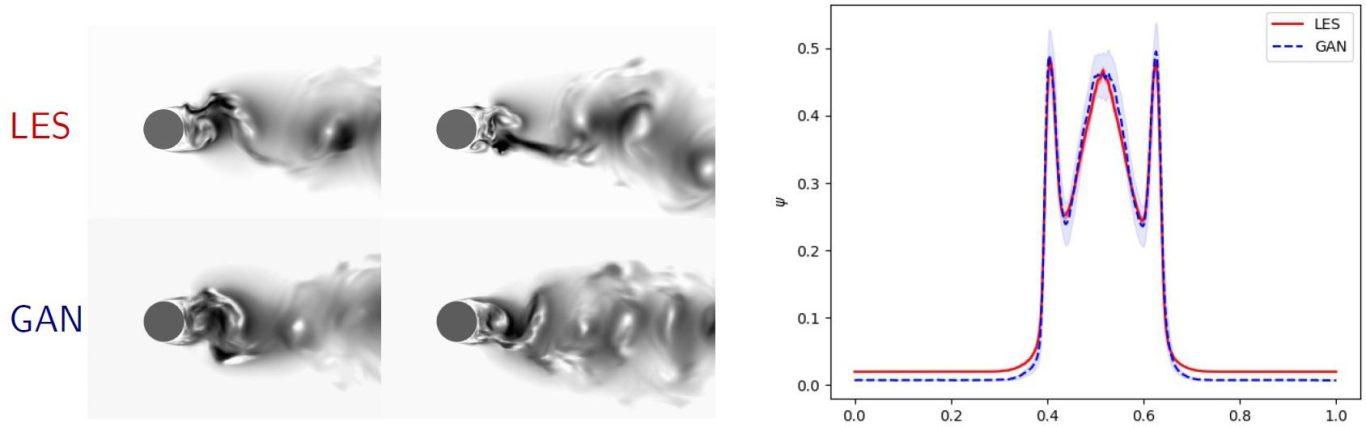
We present a mathematically grounded approach to modeling turbulent flows with generative adversarial networks (GANs). Building on ergodic theory, we show how GANs can learn to sample states from the invariant measure of a chaotic system. We study this framework from the Lorenz attractor to turbulent flows around a cylinder and a low-pressure turbine stator, using both DCGAN and conditional pix2pixHD architectures trained on large-eddy simulation (LES) data. The results show that GANs can generate high-resolution turbulent flow fields for technically challenging configurations using moderate training data. Compared with classical numerical methods, especially LES, training and inference require substantially less computational time while maintaining high output quality, with statistical properties that agree excellently with the reference simulations.
Paper in Review
When do World Models Successfully Learn Dynamical Systems?
E. Ross, C. Drygala, L. Schwarz, S. Kaiser, F. di Mare, T. Breiten, and H. Gottschalk
arXiv:2507.04898, 2025
We investigate compact latent representations with learned temporal dynamics, known as World Models, for simulating physical systems. Drawing on concepts from control theory, we explain when tokenized histories of low-dimensional states can be used to reconstruct future dynamics. We validate the framework with models of increasing complexity, from least-squares regression to generative adversarial networks, across several physical systems, including the heat and wave equations, the chaotic 2D Kuramoto–Sivashinsky equation, and a Kármán vortex street around a cylinder. The resulting models successfully reproduce the flow dynamics and achieve accuracy comparable to FNO and DeepONet in the short term, with improved long-term performance.